
Adding value for your metal plate products.


One of the most basic processes in metal forming is wire drawing. It entails the reduction of diameter in a metal wire while enhancing its surface finish and mechanical properties. Many industries, such as construction, welding, electrical, and manufacturing, use wire drawing machines for different applications. These machines offer accuracy in wire diameters, high production efficiency, and ensure repetitiveness in quality.
Whether it’s producing steel wire, stainless steel wire, copper wire, or aluminum wire, the understanding of how wire drawing machinery works plays an important role for factory owners, engineers, and procurement managers.
A wire drawing machine is an industrial machine that operates with the aim of reducing the diameters of wires that are made of metal by subjecting them to a pulling action that passes them over a series of drawing dies, thereby making them stronger and of high quality.
Wire drawing machines appropriate for processing different types of metals include:
Steel
Stainless steel
Aluminum wire
They may also be utilized to process wire rods that will be transformed into coils.
Various forms of wire drawing machines are used for specific purposes:
Straight Line Wire Drawing Machine
High-speed and high-precision
Suitable for use in an industrial production line
Water Tank Wire Drawing Machine
Wet drawing process
Ideal for Fine Wire, Welding Wire
Compact Structure
Suitable for small factories and lower volume production
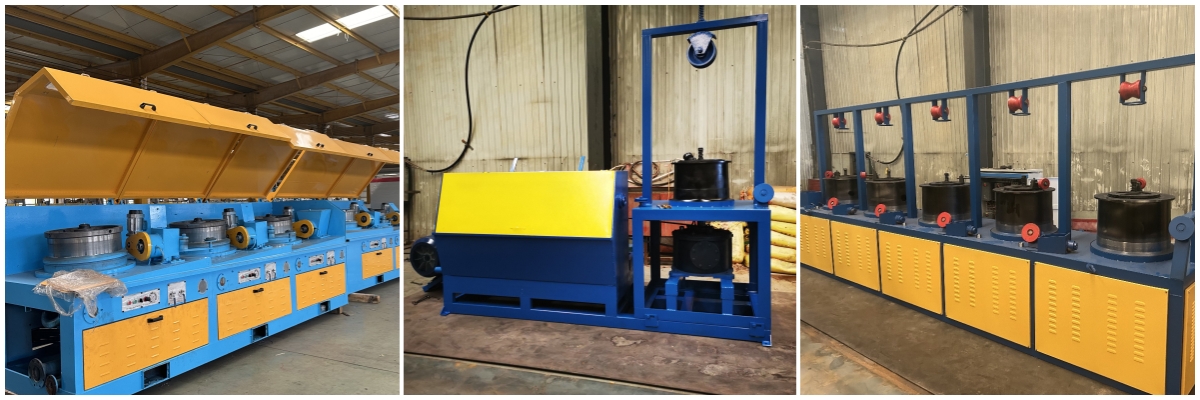
A wire drawing machine consists of several important parts that are used for specific functions to produce wires.
The pay-off system contains and also feeds wire rod or coil into the drawing line. It also makes sure that the wire unwinds uniformly with no tangling.
Drawing die, usually made from tungsten carbide or diamond, is used to decrease the diameter of the wire. Every drawing die gradually reduces the diameter until the appropriate size is reached.
The pulling force necessary to draw the wire through the die is supplied by the capstans. They also regulate the speeds and the tensions of the wire.
Lubricants also have cooling properties, which help to prevent breakage due to wire surface damage.
The take-up process coils up the finished wire in spools or coils, awaiting transportation or further processing.
Understanding the wire drawing process is crucial for factory operators and engineers. The process generally includes the following steps:
Wire rod or coil is fed into the machine from the pay-off unit. Proper alignment is critical to avoid wire breakage.
The wire passes through progressively smaller dies. Each die reduces the diameter of the wire while maintaining its tensile strength.
Lubricant reduces friction and heat during drawing. Cooling ensures consistent wire quality and extends the life of dies.
Servo systems or capstan arrangements maintain stable tension and uniform speed, ensuring smooth drawing and minimal defects.
The finished wire is collected in coils or spools, ready for storage, transport, or further processing.


 +86 19331572740
 +86 19331572740
 admin@tsshuoen.com
